When avoidance gets mistaken for personality.
There’s a definition of introversion that circulates widely and feels intuitively right: introverts are people whose energy drains with social interaction, while extroverts gain energy from it. Clean, symmetrical, useful at cocktail parties.
It’s worth noting upfront that this is a popularization, not a scientific definition. When Hans Eysenck first theorized introversion in The Biological Basis of Personality (1967), he grounded it in cortical arousal thresholds - introverts have higher baseline arousal and seek less external stimulation to avoid being overwhelmed. Subsequent psychophysiological work by Stelmack (1990) confirmed measurable autonomic and cortical differences between introverts and extroverts. The “energy” metaphor is a useful downstream simplification of this, but it has no direct empirical grounding of its own. In the Big Five framework developed by Costa & McCrae (1992), introversion isn’t defined by energy at all - it’s defined by sociability, assertiveness, and positive affect along a continuous spectrum.
But as with most clean definitions, it starts to wobble the moment you press on it. One place it wobbles badly: it offers almost no way to distinguish between someone who doesn’t want to socialize and someone who can’t do it well. And those are very different problems.
The surface looks the same
Someone with diminished social skills might avoid parties, sit quietly in group settings, prefer texting over calling, and generally keep to themselves. Sound familiar? It sounds like introversion because the behavior is nearly identical. The trouble is that behavior can be produced by entirely different underlying causes - and in this case, diagnosing the cause matters enormously.
A true introvert avoids extended social situations because they’re stimulating beyond their threshold. Critically, Cheek & Buss (1981) demonstrated empirically that introversion and shyness are distinct constructs - an introvert might be perfectly capable in social settings, even charming and well-liked, but chooses to limit exposure because of how it feels, not because of how it goes. The avoidance is a preference, not a limitation.
Someone with diminished social skills may avoid the same settings for a completely different reason: those situations are consistently difficult and unrewarding for them. Conversations misfire. They misread cues. Interactions feel effortful rather than natural. As Henderson & Zimbardo (2010) document, social anxiety is specifically characterized by fear of negative evaluation and behavioral inhibition - a fundamentally different causal structure from introversion’s low-stimulation preference, even when the outward behavior is identical.
From the outside, they look the same. From the inside, the experience is different in a way that matters: one is a want, the other is a can’t.
The 2x2 you actually need
The error is treating introversion and social skill as the same variable. They’re not. They’re orthogonal - you can be anywhere in the space between them independently.
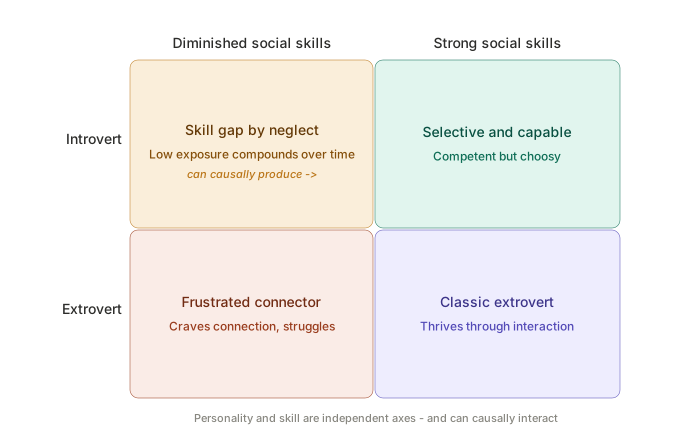
This 2x2 produces four distinct profiles:
Selective and capable (introvert, strong skills): This is the “quiet professional” archetype. They can hold a room if needed, navigate conflict gracefully, read people well - they just choose not to do it all the time. They leave the party early not because it went badly, but because they’ve hit their stimulation threshold. This is the healthiest version of introversion, and it’s what the Cheek & Buss distinction predicts most people mean when they use the word.
Skill gap by neglect (introvert, diminished skills): This is where introversion and skill deficit overlap causally. The preference for solitude is genuine, but low social exposure over time leads to real skill atrophy. The introvert isn’t avoidant because they’re bad at it - they may have gotten rusty because they’re avoidant. Ericsson, Krampe & Tesch-Romer’s (1993) foundational work on deliberate practice establishes that skills require repetition and feedback to develop and maintain - and that without practice, proficiency declines. Social skill is no exception.
Classic extrovert (extrovert, strong skills): Energized by interaction, and good at it. This is the archetype most people picture. Nothing complicated here.
Frustrated connector (extrovert, diminished skills): Perhaps the most overlooked quadrant. Someone who genuinely craves connection and feels energized by people - but whose social interactions consistently misfire. The want is real; the execution falls short. This person often suffers quietly, because “I’m an extrovert who can’t connect well” doesn’t have a tidy cultural narrative the way introversion does.
The feedback loop that hides in plain sight
The skill-gap-by-neglect quadrant deserves particular attention because it doesn’t stay static. It compounds.
Low practice leads to occasional awkwardness. Awkwardness produces mildly negative social experiences. Mildly negative experiences increase avoidance. More avoidance means less practice. Over time, a moderate introvert may develop meaningfully diminished social skills not because of anxiety or pathology - but through accumulated, gradual neglect of a domain. The Ericsson deliberate practice framework implies this directly: skills that go unpracticed regress, and the gap between capability and potential widens with time.
The trait didn’t cause the skill deficit. The trait caused the low exposure that caused the skill deficit. These are different causal claims, and they point toward different solutions. The first would suggest acceptance; the second suggests deliberate, targeted practice.
Why the introvert label is so easy to borrow
In the early 2010s, introversion became culturally fashionable in a way it hadn’t been before. Susan Cain’s Quiet: The Power of Introverts in a World That Can’t Stop Talking (2012) reframed introverts as depth-seekers unfairly penalized by an extrovert-worshipping culture. The framing was largely healthy - it pushed back against the idea that being quiet or solitude-loving meant something was wrong with you.
But a side effect appeared: the introvert label became a comfortable place to park other things. Social anxiety, skill deficits, shyness, avoidant tendencies - all of these could be quietly filed under “introvert” without the friction of having to acknowledge a problem. Introversion doesn’t need fixing; it’s a personality type to be respected. If that’s what you are, you’re off the hook. Crozier (2010) traces precisely this kind of misattribution in the developmental literature - avoidance behaviors arising from social anxiety frequently get renarrated as temperament.
This matters because the self-report problem is real. People who struggle socially often adopt the introvert identity sincerely - they’ve internalized it as a description of who they are, not as a rationalization for something that’s causing them distress.
The diagnostic question
If you want to distinguish genuine introversion from its look-alikes, the most useful question isn’t behavioral. It’s:
If social interaction felt effortless and reliably went well - would this person still want less of it?
A true introvert says yes. The social cost isn’t the primary driver; the preference for solitude and low stimulation is real and intrinsic. Remove the friction, and they’d still choose the book over the party most of the time.
Someone with diminished social skills - or with social anxiety - often says something quite different when they sit with this question honestly. The avoidance is downstream of the difficulty, not upstream of it.
One important caveat: research by Zelenski, Santoro & Whelan (2012) found that introverts who acted extroverted in experimental conditions reported higher positive affect than they’d predicted - better than expected. Fleeson, Malanos & Achille (2002) found similar results: extraverted behavior predicts positive affect even within introverts, within-person. This suggests the preference/capability split isn’t always clean - some introverts may genuinely underestimate how much they’d enjoy richer social engagement if the friction were removed. The diagnostic question remains useful, but the answer deserves to be held with some humility.
What this means practically
None of this is to say that introversion and diminished social skills are mutually exclusive - clearly they aren’t, and causality can run in both directions over a lifetime. The point is simpler: they’re not the same thing, they feel different on the inside, and conflating them forecloses growth for people who might actually want it.
The cleanest way to hold this is to treat personality and skill as separate variables worth examining independently. Are you someone who genuinely prefers less social stimulation - or someone who has learned to prefer it because that’s where the friction is lowest? Both are real. Only one is fixed.
References
Cain, S. (2012). Quiet: The Power of Introverts in a World That Can’t Stop Talking. Crown Publishers.
Cheek, J. M., & Buss, A. H. (1981). Shyness and sociability. Journal of Personality and Social Psychology, 41(2), 330-339. https://doi.org/10.1037/0022-3514.41.2.330
Costa, P. T., & McCrae, R. R. (1992). Revised NEO Personality Inventory (NEO-PI-R) and NEO Five-Factor Inventory (NEO-FFI): Professional Manual. Psychological Assessment Resources.
Crozier, W. R. (2010). Shyness and the development of embarrassment and the self-conscious emotions. In W. R. Crozier & L. E. Alden (Eds.), Handbook of the Shy and Socially Anxious (pp. 7-23). Wiley.
Ericsson, K. A., Krampe, R. T., & Tesch-Romer, C. (1993). The role of deliberate practice in the acquisition of expert performance. Psychological Review, 100(3), 363-406. https://doi.org/10.1037/0033-295X.100.3.363
Eysenck, H. J. (1967). The Biological Basis of Personality. Charles C. Thomas.
Fleeson, W., Malanos, A. B., & Achille, N. M. (2002). An intraindividual process approach to the relationship between extraversion and positive affect. Journal of Personality and Social Psychology, 83(6), 1409-1422. https://doi.org/10.1037/0022-3514.83.6.1409
Henderson, L., & Zimbardo, P. (2010). Shyness, social anxiety, and social anxiety disorder. In S. G. Hofmann & P. M. DiBartolo (Eds.), Social Anxiety: Clinical, Developmental, and Social Perspectives (2nd ed., pp. 65-92). Elsevier.
Stelmack, R. M. (1990). Biological bases of extraversion: Psychophysiological evidence. Journal of Personality, 58(1), 293-311. https://doi.org/10.1111/j.1467-6494.1990.tb00917.x
Zelenski, J. M., Santoro, M. S., & Whelan, D. C. (2012). Would introverts be better off if they acted more like extraverts? Emotion, 12(2), 290-303. https://doi.org/10.1037/a0027098